

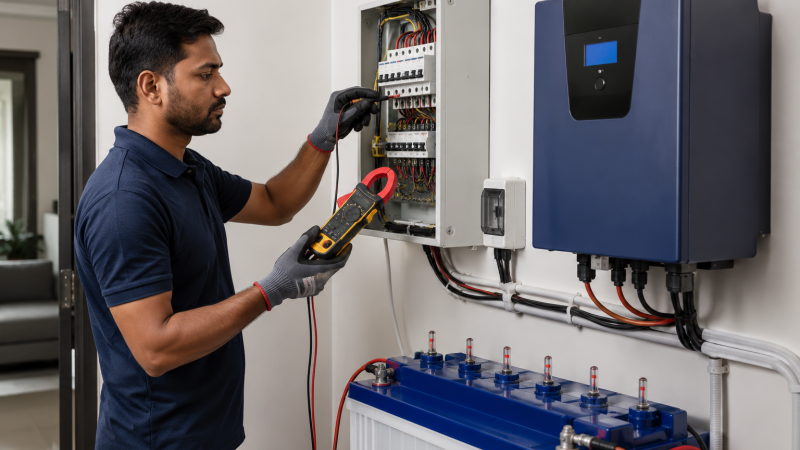
How to Calculate Inverter Size for Your Home
Choosing the right inverter size is one of the most important decisions when buying a home power backup system. An inverter that is too small may overload during a power cut, while an oversized inverter can increase your costs unnecessarily.
This guide explains how to calculate the correct inverter size for your home using a simple load calculator, appliance watt chart, and battery recommendations.
Why Choosing the Right Inverter Size Matters
A properly sized inverter offers several benefits:
- Reliable backup during power cuts
- Longer battery life
- Better efficiency
- Protection for sensitive electronics
- Lower maintenance costs
- Room for future appliances
Step 1: List the Appliances You Want to Run
Start by listing the appliances you want to use during a power outage.
- Ceiling Fans
- LED Lights
- Television
- Wi-Fi Router
- Laptop
- Desktop Computer
- CCTV System
- Refrigerator (Optional)
Home Appliance Watt Chart
| Appliance | Average Wattage |
|---|---|
| LED Bulb | 9 W |
| Tube Light | 20 W |
| Ceiling Fan | 70 W |
| LED TV | 120 W |
| Wi-Fi Router | 15 W |
| Laptop | 90 W |
| Desktop PC | 250 W |
| CCTV DVR | 40 W |
| Refrigerator | 250 W |
| Water Purifier | 40 W |
Step 2: Calculate Your Total Load
Multiply the number of appliances by their wattage.
| Appliance | Quantity | Watts | Total |
|---|---|---|---|
| Ceiling Fan | 4 | 70 W | 280 W |
| LED Bulb | 8 | 9 W | 72 W |
| LED TV | 1 | 120 W | 120 W |
| Wi-Fi Router | 1 | 15 W | 15 W |
| Laptop | 1 | 90 W | 90 W |
| Total Load | 577 W | ||
Load Calculator
Formula:
Total Load (Watts) =
(Number of Appliances × Wattage)
Example:
(4 × 70)
+
(8 × 9)
+
(1 × 120)
+
(1 × 15)
+
(1 × 90)

= 577 Watts
Add an additional 20–30% capacity for future appliances.
Recommended Load:
577 × 1.25 ≈ 720 Watts
Convert Watts to VA
Home inverters are rated in VA (Volt-Amps).
VA = Watts ÷ Power Factor

Power Factor = 0.8
Example:
720 ÷ 0.8 = 900 VA
A 900 VA or 1000 VA Pure Sine Wave Inverter would be the ideal choice.
Recommended Inverter Capacity
| Total Load | Recommended Inverter |
|---|---|
| Up to 400 W | 700 VA |
| 400–700 W | 900 VA |
| 700–900 W | 1100 VA |
| 900–1200 W | 1500 VA |
| 1200–1600 W | 2000 VA |
| Above 1600 W | 2500 VA+ |
Recommended Battery
| Inverter Size | Recommended Battery | Expected Backup* |
|---|---|---|
| 700–900 VA | 150 Ah Tubular Battery | 3–5 Hours |
| 1000–1500 VA | 180 Ah Tubular Battery | 4–6 Hours |
| 1500–2000 VA | 200 Ah Tubular Battery | 5–8 Hours |
*Backup depends on the connected load and battery condition.
Why Choose a Tubular Battery?
- Longer service life
- Better charging efficiency
- Excellent for frequent power cuts
- Low maintenance
- Reliable long-term performance
Common Buying Mistakes
- Buying an inverter based only on price.
- Ignoring future power requirements.
- Choosing the wrong battery capacity.
- Overloading the inverter.
- Purchasing from unauthorized sellers.
Frequently Asked Questions
Can I run a refrigerator on a home inverter?
Yes, provided the inverter has enough capacity to handle the refrigerator's starting surge.
Is a 150 Ah battery enough?
For small homes with moderate loads, a 150 Ah tubular battery is usually sufficient.
Which battery type is best?
Tubular batteries are recommended because they offer longer life and better performance during frequent power cuts.
Final Thoughts
Calculating the correct inverter size before purchasing ensures reliable backup, better efficiency, and longer battery life. Simply calculate your total appliance load, convert watts to VA, add 20–30% extra capacity, and choose a quality pure sine wave inverter with a suitable tubular battery.
Browse the latest range of genuine home inverters, inverter batteries, and UPS systems at Kamtush.com to find the perfect power backup solution for your home.
Leave a comment